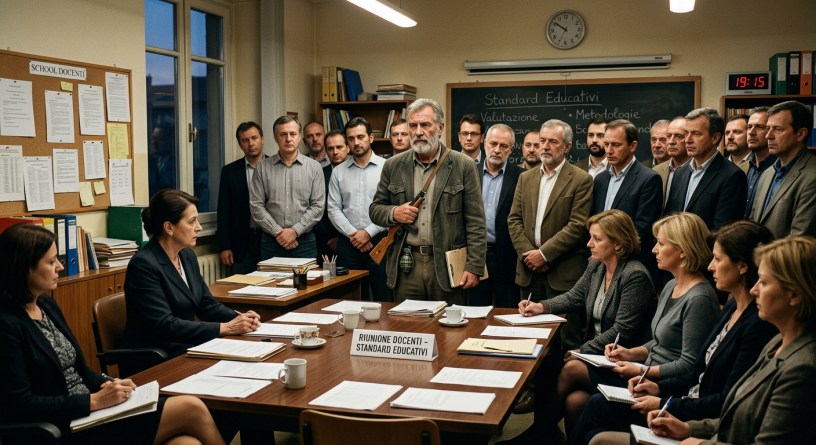
Immagine realizzata con l’ausilio dell’intelligenza artificiale a esclusivo scopo illustrativo.
The Story of the Body’s Movable Properties
After the rendezvous in the woods,
two sex workers are caught at the river.
Hidden among the reeds,
a few adolescents
have their eyes fixed on the movable properties of these women.
They have cursed anyone who speaks—
here, a curse is sweeter
than the sweetest words.
From afar, a car signal is heard.
The women take their movable properties with them
and walk toward the sound of the signal.
The adolescents remain frozen in their places,
like immovable properties.
The women, however,
through their movable properties,
brought earnings to their immovable properties.
The children of those bureaucrats
who once brought those women
to this beautiful corner
are bureaucrats themselves now.
Those women are now famous singers.
The adolescents, however,
curse themselves for being born into this world.
Their only achievement in life
has been seeing the movable properties
of these famous singers.
Their hands are now covered with calluses,
and their happiness
is as if the river had washed it away.
Their immovable properties, meanwhile,
are undocumented and in ruins.
Il veleno della forma: la scuola come teatro dell’assurdo
Titolo della recensione: Bere parole come veleno come se fossero vino
Genere: Poesia civile / Satira contemporanea
Recensione di Francesca Giordano
Nella poesia contemporanea che affronta i temi del lavoro e delle istituzioni, è raro imbattersi in un testo capace di coniugare con tale immediatezza la ferocia della satira alla gravità della testimonianza civile. Bere parole come veleno come se fossero vino si presenta come un resoconto quasi verbale, una cronaca in versi di una riunione del corpo docente che si trasforma rapidamente in un’allegoria della paralisi burocratica.
La spazialità del potere e il rituale vuoto
L’apertura della lirica definisce immediatamente una gerarchia quasi feudale: la dirigente al vertice, le insegnanti sedute, i docenti maschi costretti in piedi per due ore. La disposizione dei corpi nello spazio non è casuale; è la messa in scena di un rituale di sottomissione mascherato da dibattito sugli «standard educativi moderni».
Il testo lavora per vertiginosi cortocircuiti logici. L’esito parodistico della riunione — due ore di lezione sottratte agli studenti, la cui sola deduzione pedagogica diventa l’auspicio di futuri e continui meeting — mette a nudo lo scarto insanabile tra la retorica del rinnovamento e la concretezza della prassi scolastica.
La scheggia e il giocattolo: la verità del corpo
Il perno etico e poetico del testo risiede nella figura del docente veterano di guerra. È qui che il linguaggio della poesia scarta dalla semplice satira per toccare una dimensione tragica.
Attraverso un gioco di specchi e contrapposizioni, l’autore mette a confronto due dimensioni di irrealtà e realtà:
L’istituzione-giocattolo: Il sistema educativo, con le sue direttive astratte e la sua propaganda pedagogica, viene smascherato dall’uso che il veterano fa dei suoi sussidi didattici (il fucile, la granata, i proiettili giocattolo). La scuola stessa rivela la propria natura di finzione innocua e grottesca.
La verità della carne: A questo teatro di plastica si oppone la scheggia reale rimasta nel corpo del veterano. Il dolore fisico si riattiva di fronte alla tortura psicologica della riunione, portando l’uomo ad un’affermazione paradossale e terribile: “La guerra era migliore di questo”.
Mentre la burocrazia scolastica marcia sul posto — scansione ritmica restituita dal martellante e meccanico “Uno, due. Uno, due…” —, l’unico vero “avanzamento” è il strisciare doloroso del veterano, la cui lezione di vita supera per dignità e verità qualsiasi programma ministeriale.
La metafora del brindisi
La chiusa del testo sintetizza l’amarezza dell’intera composizione. L’atto forzato di stare in piedi si trasforma nella parodia di un brindisi d’onore. I docenti, complici e vittime al tempo stesso, mandano giù il discorso istituzionale senza opporre resistenza. La metafora del veleno scambiato per vino pregiato descrive con crudo eppur lirico realismo l’assuefazione alla retorica e la perdita di senso critico di chi dovrebbe, per professione, educare al pensiero libero.
Giudizio critico
Con uno stile essenziale, privo di orpelli retorici e debitore della grande tradizione satirica europea (da Brecht a Herbert), il testo si impone come una denuncia lucida e attualissima. Una poesia che non concede consolazioni, ma che ha il merito raro di nominare il male della burocrazia con la precisione di un bisturi.
The Poison of Form: The School as a Theater of the Absurd
Review Title: Drinking Words Like Poison as If They Were Wine
Genre: Civil Poetry / Contemporary Satire
Review by Francesca Giordano
In contemporary poetry dealing with themes of labor and institutions, it is rare to encounter a text capable of combining the ferocity of satire with the gravity of civil witness so immediately. Drinking Words Like Poison as If They Were Wine presents itself almost as verbatim transcript—a chronicle in verse of a faculty meeting that quickly transforms into an allegory of bureaucratic paralysis.
Spatiality of Power and the Empty Ritual
The opening lines of the poem immediately establish an almost feudal hierarchy: the principal at the head of the table, the female teachers seated, and the male teachers forced to stand for two hours. The arrangement of bodies in space is not accidental; it is the staging of a ritual of submission disguised as a debate on “modern educational standards.”
The text operates through dizzying logical short-circuits. The parodic outcome of the meeting—two hours of missed lessons for the students, whose sole pedagogical takeaway becomes the wish for constant future meetings—exposes the unbridgeable gulf between the rhetoric of reform and the reality of school practice.
The Shrapnel and the Toy: The Truth of the Body
The ethical and poetic centerpiece of the poem rests on the figure of the war veteran teacher. It is here that the poem’s language pivots from pure satire to touch upon a tragic dimension.
Through a game of mirrors and contrasts, the author juxtaposes two dimensions of unreality and reality:
The Toy Institution: The educational system, with its abstract directives and pedagogical propaganda, is unmasked by the veteran’s use of his teaching props (the toy rifle, grenade, and bullets). The school reveals its own nature as a harmless, grotesque fiction.
The Truth of the Flesh: Opposed to this plastic theater is the real shrapnel remaining in the veteran’s body. Physical pain reactivates in the face of the psychological torture of the meeting, leading the man to a paradoxical and terrible statement: “War was better than this.”
While the school bureaucracy marches in place—a rhythmic cadence captured by the mechanical, pounding “One, two. One, two…”—the only real “forward movement” is the veteran’s painful crawling, whose life lesson surpasses any ministerial curriculum in dignity and truth.
The Metaphor of the Toast
The poem’s conclusion synthesizes the bitterness of the entire composition. The forced act of standing turns into the parody of an honorary toast. The teachers, both accomplices and victims, swallow the institutional discourse without resistance. The metaphor of poison mistaken for fine wine describes, with raw yet lyrical realism, the habituation to rhetoric and the loss of critical thinking among those whose profession is to educate for free thought.
Critical Verdict
With a stripped-down style free of rhetorical embellishments and indebted to the great European satirical tradition (from Brecht to Herbert), the poem stands as a lucid, timely denunciation. It is a poem that offers no consolations, but possesses the rare merit of naming bureaucratic decay with surgical precision.
Per approfondire l’attualità nazionale, la cronaca, la cultura e le notizie dal territorio, visita anche Alessandria Post:
https://italianewspost.com/ e https://piercarlolava.blogspot.com/
 italianewspost.com